Proximal Humerus FractureUpper Arm (Shoulder) Fracture (Proximal Humerus Fracture)
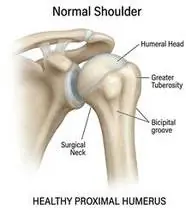
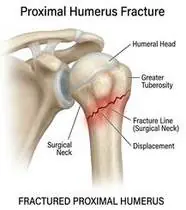
Proximal Humerus Fracture — Overview
Proximal humerus fractures involve the humeral head, surgical neck, and greater/lesser tuberosities (classified via Neer 1- to 4-part criteria), requiring careful balance between tuberosity healing and early glenohumeral mobilization.
A proximal humerus fracture (upper arm / shoulder fracture) is a break at the top rounded ball or neck of the upper arm bone where it forms the shoulder joint.
Primary Causes & Biomechanics
Key Points You Should Know
- •Fall onto an outstretched arm or direct lateral shoulder impact, especially in osteoporotic bone
- •Deforming muscular forces: supraspinatus/infraspinatus pulling the greater tuberosity superiorly-posteriorly, subscapularis pulling the lesser tuberosity medially, and pectoralis major pulling the shaft medially
- •High propensity for adhesive capsulitis, subacromial impingement (from malunited greater tuberosity), and axillary nerve neuropraxia
- •Early Pendulum Swings: Letting your arm hang relaxed and swing gently like a pendulum prevents the shoulder from freezing without disturbing the healing bone.
- •Cane & Healthy-Arm Assistance: In the middle weeks, your healthy arm guides the healing arm upward while lying flat on your back.
- •Elbow & Hand Care: Bending your elbow and squeezing your hand daily prevents dependent arm swelling.
Assessment Methods
1. Goniometric ROM & Postural / Kinematic Analysis
Glenohumeral flexion (0–180°), abduction, scapular plane elevation (scaption), and internal/external rotation measured via goniometry.
2. Special Clinical Provocation & Neurological/Functional Tests
Axillary nerve sensory testing over the lateral deltoid ('regimental badge' patch), isometric rotator cuff integrity after radiographic consolidation, and scapulohumeral rhythm analysis.
3. Standardized Clinical Outcome Scales & Imaging Criteria
Constant-Murley Shoulder Score, DASH / QuickDASH, VAS pain score, and serial AP/scapular-Y/axillary radiographs.
1. Range of Motion & Posture Check
Your physiotherapist gently evaluates how comfortably and smoothly your proximal humerus (humeral head, surgical/anatomical neck, and greater/lesser tuberosities) moves and checks your overall posture.
2. Muscle Strength & Functional Movement Check
Your muscle balance, walking or reaching comfort, and specific gentle movement tests are evaluated without triggering sharp pain.
3. Typical Symptoms & Daily Impact Review
Acute proximal shoulder pain, inability to actively elevate the arm, and gravitational ecchymosis (Hennequin's sign) spreading down the chest wall and arm within 48–72 hours.
Treatment Options & Phase-Based Protocol
✨ Enriched GIF Exercise & Precaution GuidePhase 1: Acute Symptom Modulation, Tissue Protection & Early Activation
- •Phase 1 Clinical Focus & Tissue Protection: Protection & Pendulum Phase (Weeks 1–3): Velpeau/shoulder sling immobilization, active hand/wrist/elbow ROM, postural scapular retraction, and gravity-assisted Codman's pendulum exercises (no active shoulder abduction!).
- •Pain, Edema & Neuromuscular Modulation: Targeted physical modalities, relative load management, and early protected mobility of the proximal humerus (humeral head, surgical/anatomical neck, and greater/lesser tuberosities) without provoking mechanical or inflammatory irritation.
- •Proximal & Distal Kinetic Chain Maintenance: Maintain active mobility and circulation in adjacent joints while protecting the primary healing structures in Proximal Humerus Fracture.
Phase 2: Progressive Mobility, Motor Control & Targeted Strengthening
- •Phase 2 Progressive Mobilization & Motor Control: Active-Assisted Phase (Weeks 3–6): Supine wand-assisted (cane) flexion, pulley-assisted elevation, and table slides as callus forms; avoid strong resisted external/internal rotation if tuberosities are fractured.
- •Biomechanical Alignment & Co-Contraction: Restore balanced agonist-antagonist force couples, joint centration, and multi-planar neuromuscular control across the proximal humerus (humeral head, surgical/anatomical neck, and greater/lesser tuberosities).
- •Myofascial Extensibility & Endurance: Address secondary compensatory tightness and build local muscular endurance within safe, symptom-free biomechanical parameters.
Phase 3: Functional Integration, Proprioception & Long-Term Prevention
- •Phase 3 Functional Integration & Long-Term Prevention: Dynamic Strengthening & Scapulohumeral Rhythm (Week 6–12+): Towel-supported external rotation, scapular plane Full-Can elevation, elastic band rotator cuff strengthening, and posterior capsule stretching.
- •Proprioceptive Balance & Dynamic Loading: Progress to task-specific closed-chain, balance, and functional movement patterns tailored to daily life, occupational, or athletic demands.
- •Self-Management & Relapse Prophylaxis: Establish lifelong ergonomic habits, home exercise maintenance, and early warning-sign awareness to prevent recurrence.
Step 1: Calming Pain, Protecting the Area & Gentle Starter Motion
- •Early Pendulum Swings: Letting your arm hang relaxed and swing gently like a pendulum prevents the shoulder from freezing without disturbing the healing bone.
- •Calm Protection & Gentle Start: During the initial stage of Upper Arm (Shoulder) Fracture, avoid painful overloading and perform the gentle, pain-free starter movements shown below to support circulation and comfort.
- •Respecting Your Body's Signals: Every movement should stay within a comfortable, non-painful zone—never force through sharp or radiating pain.
Step 2: Restoring Flexibility & Building Supporting Muscle Strength
- •Cane & Healthy-Arm Assistance: In the middle weeks, your healthy arm guides the healing arm upward while lying flat on your back.
- •Step-by-Step Flexibility & Support: As acute sensitivity settles, gradually build mobility and strengthen the supporting muscles around the joint at a steady, controlled pace.
- •Posture & Breathing Coordination: Keep your posture upright and breathe smoothly (never hold your breath!) during every repetition.
Step 3: Safe Daily Habits, Stamina & Preventing Recurrence
- •Elbow & Hand Care: Bending your elbow and squeezing your hand daily prevents dependent arm swelling.
- •Confident Return to Daily Life: Integrate your stronger muscles and improved balance into walking, stairs, work, and recreational activities.
- •Preventing Future Flare-Ups: Continue your core protective habits and key maintenance exercises even after symptoms resolve.
Animated (GIF) Therapeutic Exercise Guide
Animated clinical exercise protocol with biomechanical angles, target muscle groups, and dosage parameters (Click image to enlarge)
Step-by-step animated exercise demonstrations you can safely perform at home (Click image to enlarge)
 🔍 Enlarge
1. Codman's Pendulum Glenohumeral Decompression Exercise
1. Bent-Over Gentle Arm Pendulum Swings
Trunk flexed forward 45°–60° with the sound hand supported on a table while the affected arm hangs completely relaxed like a plumb line. Momentum from gentle trunk sway creates passive glenohumeral distraction and synovial lubrication without rotator cuff firing. Specifically indicated in Proximal Humerus Fracture rehabilitation to optimize proximal humerus (humeral head, surgical/anatomical neck, and greater/lesser tuberosities) biomechanics and neuromuscular control.
Lean forward supporting your healthy hand on a table and let your affected arm hang completely relaxed toward the floor. Gently sway your body to let the arm swing in small pain-free circles without using your shoulder muscles. Perform smoothly within a comfortable, pain-free range to support your Upper Arm (Shoulder) Fracture recovery.
 🔍 Enlarge
2. Supine Wand-Assisted (Cane) Active-Assisted Shoulder Elevation
2. Lying Cane/Stick-Assisted Two-Handed Arm Raise
In supine (scapula stabilized against the plinth and gravity eliminated in the final arc), the unaffected upper extremity guides a wand/stick to elevate the affected shoulder smoothly without deltoid-induced superior humeral shear. Specifically indicated in Proximal Humerus Fracture rehabilitation to optimize proximal humerus (humeral head, surgical/anatomical neck, and greater/lesser tuberosities) biomechanics and neuromuscular control.
Lie on your back holding a light stick or cane with both hands. Use your healthy arm to gently guide both arms up overhead as far as comfortable, hold for 3 seconds, and slowly lower. Perform smoothly within a comfortable, pain-free range to support your Upper Arm (Shoulder) Fracture recovery.
 🔍 Enlarge
3. Graduated Wall Finger-Walk (Spider Climb) Active-Assisted Elevation
3. Wall Finger-Climbing (Spider Walk) Exercise
Facing or standing perpendicular to a wall, walking the fingers progressively upward to achieve controlled active-assisted glenohumeral flexion/scaption while avoiding compensatory trunk lean or shoulder shrugging. Specifically indicated in Proximal Humerus Fracture rehabilitation to optimize proximal humerus (humeral head, surgical/anatomical neck, and greater/lesser tuberosities) biomechanics and neuromuscular control.
Stand facing a wall and gently walk your fingers up the wall like a spider as high as you comfortably can without shrugging your shoulder, hold for 5 seconds, and walk your fingers back down. Perform smoothly within a comfortable, pain-free range to support your Upper Arm (Shoulder) Fracture recovery.
 🔍 Enlarge
4. Towel-Supported Glenohumeral External Rotation (Infraspinatus & Teres Minor)
4. Outward Forearm Rotation with Rolled Towel Under Elbow
External rotation performed at 90° elbow flexion with a rolled towel placed between the elbow and trunk (20°–30° scaption). Enhances infraspinatus/teres minor recruitment while preventing superior humeral head migration and deltoid shear. Specifically indicated in Proximal Humerus Fracture rehabilitation to optimize proximal humerus (humeral head, surgical/anatomical neck, and greater/lesser tuberosities) biomechanics and neuromuscular control.
Place a small rolled towel between your elbow and your side with your elbow bent at 90 degrees. Keeping your elbow pressed gently against the towel, rotate your forearm outward, hold for 3 seconds, and return slowly. Perform smoothly within a comfortable, pain-free range to support your Upper Arm (Shoulder) Fracture recovery.
 🔍 Enlarge
5. Scapulothoracic Retraction & Depression (Middle/Lower Trapezius & Rhomboids)
5. Shoulder Blade Squeeze (Postural Alignment)
Adduction and depression of the scapulae via the middle/lower trapezius and rhomboids while inhibiting upper trapezius overactivity. Corrects anterior scapular tilt, widens the subacromial outlet, and unloads the anterior thoracic column. Specifically indicated in Proximal Humerus Fracture rehabilitation to optimize proximal humerus (humeral head, surgical/anatomical neck, and greater/lesser tuberosities) biomechanics and neuromuscular control.
Sit or stand tall. Keep your shoulders relaxed away from your ears, gently draw your shoulder blades together and slightly downward toward your back pockets, hold for 5 seconds, and release. Perform smoothly within a comfortable, pain-free range to support your Upper Arm (Shoulder) Fracture recovery.
 🔍 Enlarge
6. Scapular Plane 'Full-Can' Elevation (30° Scaption, Thumb Up)
6. Thumb-Up Diagonal Arm Raise (Full-Can)
Active elevation in the scapular plane (30° anterior to the frontal plane) with external rotation (thumb pointing up) to shoulder height. Clears the greater tuberosity beneath the acromion and optimizes the deltoid-rotator cuff force couple. Specifically indicated in Proximal Humerus Fracture rehabilitation to optimize proximal humerus (humeral head, surgical/anatomical neck, and greater/lesser tuberosities) biomechanics and neuromuscular control.
Stand tall with your thumb pointing upward like a 'thumbs-up' sign. Raise your arm slightly forward and to the side (at a 30-degree angle) up to shoulder height without shrugging your shoulder, then lower slowly. Perform smoothly within a comfortable, pain-free range to support your Upper Arm (Shoulder) Fracture recovery.
Movements to Avoid & Strict Precautions
1. Active Unassisted Arm Lifting or Abduction in Weeks 1–3
1. Lifting your injured arm out to the side under its own muscle power during the first 3–4 weeks
2. Pushing Up From a Chair or Bed Using the Fractured Arm
2. Pushing yourself up from bed or a chair using your fractured arm
3. Forceful External Rotation Against Resistance Before Tuberosity Union
3. Forcing your arm outward or carrying heavy bags before your doctor confirms bone healing
4. Keeping the Elbow & Fingers Immobilized Inside the Sling
4. Never taking your forearm out to gently bend your elbow and fingers (when approved)
Proximal Humerus Fracture — Video Guide
Click directly on any video to open and watch in a window, or review details via 📋 Summary & Options.
Condition Overview Video (1 Video)
Summary of pathophysiology, biomechanics, and clinical presentation
What the condition is, why it develops, and its basic mechanism

What Are Shoulder Fractures (Proximal Humerus Fracture)? How Are They Treated?
Proximal humerus fractures involve the humeral head, surgical neck, and greater/lesser tuberosities (classified via Neer 1- to 4-part criteria), requiring careful balance between tuberosity healing and early glenohumeral mobilization.
A proximal humerus fracture (upper arm / shoulder fracture) is a break at the top rounded ball or neck of the upper arm bone where it forms the shoulder joint.
Treatment and Exercise Videos
Phase-based physiotherapy protocols, mobilization, and therapeutic exercises
Step-by-step recovery and safe home exercise applications

Exercises After Shoulder Fractures and Surgery (Pendulum Phase)
Phase 1: Acute Symptom Modulation, Tissue Protection & Early Activation: Phase 1 Clinical Focus & Tissue Protection: Protection & Pendulum Phase (Weeks 1–3): Velpeau/shoulder sling immobilization, active hand/wrist/elbow ROM, postural scapular retraction, and gravity-assisted Codman's pendulum exercises (no active shoulder abduction!).
Step 1: Calming Pain, Protecting the Area & Gentle Starter Motion: Early Pendulum Swings: Letting your arm hang relaxed and swing gently like a pendulum prevents the shoulder from freezing without disturbing the healing bone.

Progressive Rehabilitation Exercises After Shoulder Fractures and Surgery
Phase 2: Progressive Mobility, Motor Control & Targeted Strengthening: Phase 2 Progressive Mobilization & Motor Control: Active-Assisted Phase (Weeks 3–6): Supine wand-assisted (cane) flexion, pulley-assisted elevation, and table slides as callus forms; avoid strong resisted external/internal rotation if tuberosities are fractured.
Step 2: Restoring Flexibility & Building Supporting Muscle Strength: Cane & Healthy-Arm Assistance: In the middle weeks, your healthy arm guides the healing arm upward while lying flat on your back.
Clinical Assessment, Goniometry & Special Test Videos
Displayed only in Healthcare Professional mode (hidden in Patient mode)
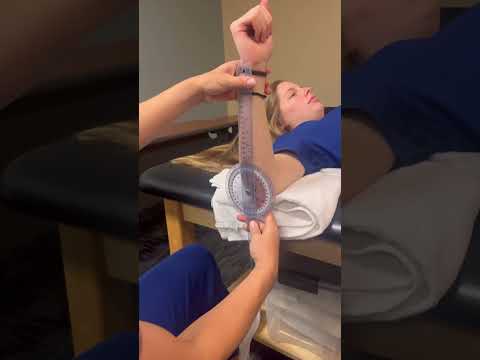
Shoulder Joint Goniometric Measurement (Flexion, Abduction, Internal & External Rotation)
Goniometric ROM & Postural / Kinematic Analysis: Glenohumeral flexion (0–180°), abduction, scapular plane elevation (scaption), and internal/external rotation measured via goniometry.

Systematic Shoulder Joint Physical Examination and Clinical Assessment
Special Clinical Provocation & Neurological/Functional Tests: Axillary nerve sensory testing over the lateral deltoid ('regimental badge' patch), isometric rotator cuff integrity after radiographic consolidation, and scapulohumeral rhythm analysis.