Muscle Contusion & Myositis Ossificans PreventionMuscle Bruise & Direct Impact Injury (Muscle Contusion)
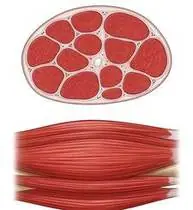
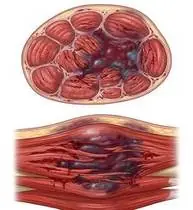
Muscle Contusion & Myositis Ossificans Prevention — Overview
A muscle contusion ('Charley Horse' / direct blunt muscle blow) occurs when a direct external compressive force (an opponent's knee, helmet, or ball in contact sports) crushes relaxed or contracting muscle fibers directly against the underlying hard bone shaft (most commonly the deep vastus intermedius against the anterior femur). It produces either an Intermuscular Hematoma (fascial sheath torn; blood drains distally via gravity causing visible bruising and rapid recovery) or an Intramuscular Hematoma (fascia intact; blood is trapped under high pressure inside the muscle compartment, carrying high risk of Traumatic Myositis Ossificans [heterotopic bone calcification inside the muscle]!).
A muscle contusion (muscle bruise / 'Charley horse') is a direct crushing bruise of a muscle—most often when another player's knee hits the front of your thigh in sports—causing bleeding and swelling deep inside the muscle fibers against the bone.
Primary Causes & Biomechanics
Key Points You Should Know
- •Direct blunt impact crushing muscle fibers and capillaries against the femoral or tibial cortex
- •Jackson & Feagin Grading: Mild (active knee flexion >90°), Moderate (active knee flexion 45°–90°), Severe (active knee flexion <45°, severe swelling and gait loss)
- •Myositis Ossificans Trigger: Applying heat, alcohol, vigorous massage, or forced stretching to an acute hematoma stimulates mesenchymal stem cells to differentiate into osteoblasts, forming a hard bone mass inside the muscle at 2–4 weeks!
- •The First 24-Hour Bent-Knee Secret: Right after a deep thigh bruise, gently wrapping the thigh with the knee bent as far as comfortably possible (up to 120°) with ice acts like an internal pressure bandage that stops bleeding inside the muscle and cuts recovery time in half!
- •STRICTLY NO Massage or Heat (Prevents Bone Forming Inside the Muscle!): Rubbing, massaging, or putting heat on a bruised thigh restarts internal bleeding and can cause the bruise to turn into a hard piece of bone inside your muscle (Myositis Ossificans)!
- •Gradual Return & Protection: Restoring full pain-free flexibility and strength before returning to high-impact loads protects the skeletal muscle belly (most commonly quadriceps vastus intermedius / rectus femoris or gastrocnemius) and underlying periosteum from re-injury.
Assessment Methods
1. Goniometric ROM & Postural / Kinematic Analysis
Active pain-free knee flexion goniometry (measured at 24–48h to classify Jackson Grade I, II, or III severity) and thigh circumference measurement.
2. Special Clinical Provocation & Neurological/Functional Tests
West Point / Aronen 120° Knee Flexion Protocol Check (inability to flex the knee past 45–60° indicates severe intramuscular bleeding).
3. Standardized Clinical Outcome Scales & Imaging Criteria
Diagnostic ultrasound or X-ray at 3–4 weeks (if hardening/loss of flexion suggests Myositis Ossificans), and LEFS.
1. Range of Motion & Posture Check
Your physiotherapist gently evaluates how comfortably and smoothly your skeletal muscle belly (most commonly quadriceps vastus intermedius / rectus femoris or gastrocnemius) and underlying periosteum moves and checks your overall posture.
2. Muscle Strength & Functional Movement Check
Your muscle balance, walking or reaching comfort, and specific gentle movement tests are evaluated without triggering sharp pain.
3. Typical Symptoms & Daily Impact Review
Immediate localized blunt pain, rapid tense swelling, and hematoma formation at the site of direct impact, accompanied by pain and tightness when trying to bend the knee (if in the thigh) or straighten the joint.
Treatment Options & Phase-Based Protocol
✨ Enriched GIF Exercise & Precaution GuidePhase 1: Acute Symptom Modulation, Tissue Protection & Early Activation
- •Phase 1 Clinical Focus & Tissue Protection: Acute Hemorrhage Tamponade Phase (First 24–48 Hours — CRITICAL!): Immobilize the quadriceps immediately in 120° of passive knee flexion (or maximum pain-free flexion) with an elastic compression wrap + ice for 24 hours! This internal tamponade stops intramuscular capillary bleeding and preserves muscle length; perform gentle ankle pumps.
- •Pain, Edema & Neuromuscular Modulation: Targeted physical modalities, relative load management, and early protected mobility of the skeletal muscle belly (most commonly quadriceps vastus intermedius / rectus femoris or gastrocnemius) and underlying periosteum without provoking mechanical or inflammatory irritation.
- •Proximal & Distal Kinetic Chain Maintenance: Maintain active mobility and circulation in adjacent joints while protecting the primary healing structures in Muscle Contusion.
Phase 2: Progressive Mobility, Motor Control & Targeted Strengthening
- •Phase 2 Progressive Mobilization & Motor Control: Pain-Free Active Motion Phase (Days 3–14): NEVER force passive stretching! Perform pain-free active/active-assisted supine heel slides, isometric quadriceps sets, and side-lying hip abduction.
- •Biomechanical Alignment & Co-Contraction: Restore balanced agonist-antagonist force couples, joint centration, and multi-planar neuromuscular control across the skeletal muscle belly (most commonly quadriceps vastus intermedius / rectus femoris or gastrocnemius) and underlying periosteum.
- •Myofascial Extensibility & Endurance: Address secondary compensatory tightness and build local muscular endurance within safe, symptom-free biomechanical parameters.
Phase 3: Functional Integration, Proprioception & Long-Term Prevention
- •Phase 3 Functional Integration & Long-Term Prevention: Closed-Chain Functional & Contact Protection Phase (Week 2–6): Seated terminal knee extension, wall mini-squats, chair sit-to-stand, single-leg balance, and wearing a hard-shell thigh pad upon return to contact sports.
- •Proprioceptive Balance & Dynamic Loading: Progress to task-specific closed-chain, balance, and functional movement patterns tailored to daily life, occupational, or athletic demands.
- •Self-Management & Relapse Prophylaxis: Establish lifelong ergonomic habits, home exercise maintenance, and early warning-sign awareness to prevent recurrence.
Step 1: Calming Pain, Protecting the Area & Gentle Starter Motion
- •The First 24-Hour Bent-Knee Secret: Right after a deep thigh bruise, gently wrapping the thigh with the knee bent as far as comfortably possible (up to 120°) with ice acts like an internal pressure bandage that stops bleeding inside the muscle and cuts recovery time in half!
- •Calm Protection & Gentle Start: During the initial stage of Muscle Bruise & Direct Impact Injury, avoid painful overloading and perform the gentle, pain-free starter movements shown below to support circulation and comfort.
- •Respecting Your Body's Signals: Every movement should stay within a comfortable, non-painful zone—never force through sharp or radiating pain.
Step 2: Restoring Flexibility & Building Supporting Muscle Strength
- •STRICTLY NO Massage or Heat (Prevents Bone Forming Inside the Muscle!): Rubbing, massaging, or putting heat on a bruised thigh restarts internal bleeding and can cause the bruise to turn into a hard piece of bone inside your muscle (Myositis Ossificans)!
- •Step-by-Step Flexibility & Support: As acute sensitivity settles, gradually build mobility and strengthen the supporting muscles around the joint at a steady, controlled pace.
- •Posture & Breathing Coordination: Keep your posture upright and breathe smoothly (never hold your breath!) during every repetition.
Step 3: Safe Daily Habits, Stamina & Preventing Recurrence
- •Gradual Return & Protection: Restoring full pain-free flexibility and strength before returning to high-impact loads protects the skeletal muscle belly (most commonly quadriceps vastus intermedius / rectus femoris or gastrocnemius) and underlying periosteum from re-injury.
- •Confident Return to Daily Life: Integrate your stronger muscles and improved balance into walking, stairs, work, and recreational activities.
- •Preventing Future Flare-Ups: Continue your core protective habits and key maintenance exercises even after symptoms resolve.
Animated (GIF) Therapeutic Exercise Guide
Animated clinical exercise protocol with biomechanical angles, target muscle groups, and dosage parameters (Click image to enlarge)
Step-by-step animated exercise demonstrations you can safely perform at home (Click image to enlarge)
 🔍 Enlarge
1. Supine Active-Assisted Heel Slide & Synovial Diffusion Mobilization
1. Supine Heel Slide (Gentle Knee & Hip Bending)
Controlled flexion and extension of the lower extremity by sliding the heel along the support surface without axial weight-bearing. Stimulates synovial fluid diffusion across avascular cartilage and prevents capsular adhesions. Specifically indicated in Muscle Contusion rehabilitation to optimize skeletal muscle belly (most commonly quadriceps vastus intermedius / rectus femoris or gastrocnemius) and underlying periosteum biomechanics and neuromuscular control.
While lying on your back, slowly slide your heel along the bed sheet toward your hip within a comfortable, pain-free angle, hold for 3 seconds, and gently slide it back out straight. Perform smoothly within a comfortable, pain-free range to support your Muscle Bruise & Direct Impact Injury recovery.
 🔍 Enlarge
2. Rhythmic Active Ankle Dorsiflexion & Plantarflexion Pumping (Venous/Edema Pump)
2. Ankle Toe-Pulls and Pointing (Circulation & Swelling Pump)
Rhythmic alternating contraction of the tibialis anterior and gastrocnemius-soleus complex. Activates the deep venous calf pump to prevent deep vein thrombosis (DVT), clears distal edema, and maintains talocrural mobility. Specifically indicated in Muscle Contusion rehabilitation to optimize skeletal muscle belly (most commonly quadriceps vastus intermedius / rectus femoris or gastrocnemius) and underlying periosteum biomechanics and neuromuscular control.
While lying down or sitting with your legs supported, pull your toes and feet firmly upward toward your shins, hold for 3 seconds, then point them downward like pressing a gas pedal. Perform smoothly within a comfortable, pain-free range to support your Muscle Bruise & Direct Impact Injury recovery.
 🔍 Enlarge
3. Straight Leg Raise (SLR — Multi-Plane Isometric Knee Lock)
3. Supine Straight Leg Raise
Maintaining the knee locked in full extension (0°) with ankle dorsiflexion while elevating the lower extremity to 45° hip flexion. Strengthens the quadriceps and iliopsoas complex without compressing or shearing the articular surfaces. Specifically indicated in Muscle Contusion rehabilitation to optimize skeletal muscle belly (most commonly quadriceps vastus intermedius / rectus femoris or gastrocnemius) and underlying periosteum biomechanics and neuromuscular control.
Bend your healthy knee with the foot flat on the bed. Tighten the thigh muscle of your affected leg to lock the knee straight, lift the leg to the height of the opposite knee, hold for 3 seconds, and lower slowly. Perform smoothly within a comfortable, pain-free range to support your Muscle Bruise & Direct Impact Injury recovery.
 🔍 Enlarge
4. Protected Closed-Kinetic-Chain Wall Mini-Squat (0°–40° Safe Arc)
4. Wall-Supported Safe Mini-Squat
Closed-kinetic-chain bilateral knee flexion in the safe 0°–40° arc with the back supported against a wall. Promotes quadriceps-hamstring-gluteal co-contraction and joint proprioception without excessive patellofemoral compression. Specifically indicated in Muscle Contusion rehabilitation to optimize skeletal muscle belly (most commonly quadriceps vastus intermedius / rectus femoris or gastrocnemius) and underlying periosteum biomechanics and neuromuscular control.
Lean your back flat against a wall with your feet shoulder-width apart. Slowly bend your knees slightly (30–40 degrees, keeping knees behind toes), hold for 5 seconds, and push back up. Perform smoothly within a comfortable, pain-free range to support your Muscle Bruise & Direct Impact Injury recovery.
 🔍 Enlarge
5. Isometric Quadriceps Setting (Popliteal Towel Press)
5. Under-Knee Towel Press (Quadriceps Tightening)
Isometric compression of a rolled towel beneath the popliteal fossa into the surface with simultaneous ankle dorsiflexion. Activates the Vastus Medialis Obliquus (VMO) and overcomes arthrogenic muscle inhibition with 0° joint shear stress. Specifically indicated in Muscle Contusion rehabilitation to optimize skeletal muscle belly (most commonly quadriceps vastus intermedius / rectus femoris or gastrocnemius) and underlying periosteum biomechanics and neuromuscular control.
Place a small rolled towel under your knee while lying on your back or sitting with your leg straight. Pull your toes toward you while firmly pressing the back of your knee down into the towel, hold for 5 seconds, and relax while exhaling. Perform smoothly within a comfortable, pain-free range to support your Muscle Bruise & Direct Impact Injury recovery.
 🔍 Enlarge
6. Seated Terminal Knee Extension (Open/Closed Chain VMO Focus)
6. Seated Knee Straightening & Hold
Concentric extension of the knee to the final 30°–0° terminal arc with isometric hold and ankle dorsiflexion. Restores terminal knee extension torque and stabilizes dynamic patellofemoral tracking. Specifically indicated in Muscle Contusion rehabilitation to optimize skeletal muscle belly (most commonly quadriceps vastus intermedius / rectus femoris or gastrocnemius) and underlying periosteum biomechanics and neuromuscular control.
Sit upright in a chair and slowly straighten your knee completely while pulling your toes toward you. Feel the front thigh muscle tighten, hold for 5 seconds, and slowly lower your foot. Perform smoothly within a comfortable, pain-free range to support your Muscle Bruise & Direct Impact Injury recovery.
Movements to Avoid & Strict Precautions
1. Deep Tissue Massage, Foam Rolling, or Shockwave Over a Bruised Muscle (Causes Myositis Ossificans Bone Growth!)
1. Massaging, rubbing, or foam-rolling a bruised muscle (can cause bone calcification inside the muscle!)
2. Applying Heat Packs, Hot Baths, Sauna, or Alcohol in the First 72 Hours (Increases Internal Bleeding!)
2. Applying heat, taking hot baths, or drinking alcohol in the first 3–5 days
3. Forceful Passive Stretching Past the Pain Threshold
3. Forcefully pulling your heel to your buttock through sharp pain
4. Returning to Contact Sports Without Full Knee Bending and Protective Padding
4. Returning to contact sports before you can bend your knee fully and without wearing a protective pad
Muscle Contusion & Myositis Ossificans Prevention — Video Guide
Click directly on any video to open and watch in a window, or review details via 📋 Summary & Options.
Condition Overview Video (1 Video)
Summary of pathophysiology, biomechanics, and clinical presentation
What the condition is, why it develops, and its basic mechanism

How Are Muscle Contusions (Bruises) and Direct Muscle Injuries Treated?
A muscle contusion ('Charley Horse' / direct blunt muscle blow) occurs when a direct external compressive force (an opponent's knee, helmet, or ball in contact sports) crushes relaxed or contracting muscle fibers directly against the underlying hard bone shaft (most commonly the deep vastus intermedius against the anterior femur). It produces either an Intermuscular Hematoma (fascial sheath torn; blood drains distally via gravity causing visible bruising and rapid recovery) or an Intramuscular Hematoma (fascia intact; blood is trapped under high pressure inside the muscle compartment, carrying high risk of Traumatic Myositis Ossificans [heterotopic bone calcification inside the muscle]!).
A muscle contusion (muscle bruise / 'Charley horse') is a direct crushing bruise of a muscle—most often when another player's knee hits the front of your thigh in sports—causing bleeding and swelling deep inside the muscle fibers against the bone.
Treatment and Exercise Videos
Phase-based physiotherapy protocols, mobilization, and therapeutic exercises
Step-by-step recovery and safe home exercise applications

Quadriceps (Anterior Thigh) Strengthening and Rehabilitation Exercises
Phase 1: Acute Symptom Modulation, Tissue Protection & Early Activation: Phase 1 Clinical Focus & Tissue Protection: Acute Hemorrhage Tamponade Phase (First 24–48 Hours — CRITICAL!): Immobilize the quadriceps immediately in 120° of passive knee flexion (or maximum pain-free flexion) with an elastic compression wrap + ice for 24 hours! This internal tamponade stops intramuscular capillary bleeding and preserves muscle length; perform gentle ankle pumps.
Step 1: Calming Pain, Protecting the Area & Gentle Starter Motion: The First 24-Hour Bent-Knee Secret: Right after a deep thigh bruise, gently wrapping the thigh with the knee bent as far as comfortably possible (up to 120°) with ice acts like an internal pressure bandage that stops bleeding inside the muscle and cuts recovery time in half!

Quadriceps (Anterior Thigh) Stretching and Mobilization Exercises
Phase 2: Progressive Mobility, Motor Control & Targeted Strengthening: Phase 2 Progressive Mobilization & Motor Control: Pain-Free Active Motion Phase (Days 3–14): NEVER force passive stretching! Perform pain-free active/active-assisted supine heel slides, isometric quadriceps sets, and side-lying hip abduction.
Step 2: Restoring Flexibility & Building Supporting Muscle Strength: STRICTLY NO Massage or Heat (Prevents Bone Forming Inside the Muscle!): Rubbing, massaging, or putting heat on a bruised thigh restarts internal bleeding and can cause the bruise to turn into a hard piece of bone inside your muscle (Myositis Ossificans)!
Clinical Assessment, Goniometry & Special Test Videos
Displayed only in Healthcare Professional mode (hidden in Patient mode)

Knee Joint Goniometric Measurement (Active & Passive Flexion / Extension ROM)
Goniometric ROM & Postural / Kinematic Analysis: Active pain-free knee flexion goniometry (measured at 24–48h to classify Jackson Grade I, II, or III severity) and thigh circumference measurement.

Manual Muscle Testing (MRC 0–5 Grading) — Clinical Motor Strength Examination
Special Clinical Provocation & Neurological/Functional Tests: West Point / Aronen 120° Knee Flexion Protocol Check (inability to flex the knee past 45–60° indicates severe intramuscular bleeding).