Scaphoid (Carpal) FractureWrist Scaphoid Bone Fracture (Scaphoid Fracture)
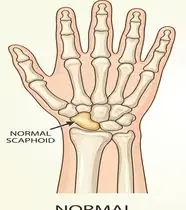
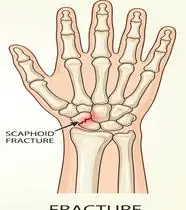
Scaphoid (Carpal) Fracture — Overview
The scaphoid is the most frequently fractured carpal bone (~60–70% of carpal fractures), bridging the proximal and distal carpal rows. Because blood supply from the dorsal carpal branch of the radial artery enters distally and flows retrogradely, waist and proximal pole fractures carry a high risk of non-union and avascular necrosis (Preiser's disease).
A scaphoid fracture (wrist boat-bone fracture) is a break in the small, boat-shaped bone at the base of your thumb following a fall onto your hand. Because its blood supply enters from one end, protecting it until complete healing is essential.
Primary Causes & Biomechanics
Key Points You Should Know
- •Fall onto a hyperextended (>95°) and radially deviated wrist (FOOSH)
- •Retrograde intraosseous vascularity leaving the proximal pole vulnerable to ischemia and non-union
- •Prolonged thumb spica cast immobilization (6–12 weeks) causing radiocarpal, thumb CMC/MCP, and forearm rotational stiffness
- •Why Healing Takes Longer: The scaphoid has a delicate one-way blood supply, so wearing your thumb cast/splint faithfully protects the bone from losing circulation.
- •Keep Uncasted Finger Joints Moving: Bending the tips of your index, middle, ring, and little fingers daily keeps hand tendons gliding smoothly.
- •Pinch & Grip After Healing: Once your doctor confirms solid bone healing on X-ray/CT, thumb-touching and soft ball squeezes restore hand strength.
Assessment Methods
1. Goniometric ROM & Postural / Kinematic Analysis
Wrist flexion/extension, radial/ulnar deviation, forearm supination/pronation, and thumb palmar/radial abduction and opposition.
2. Special Clinical Provocation & Neurological/Functional Tests
Anatomical snuffbox tenderness, Scaphoid Tubercle palpation, Axial Thumb Compression test, and Watson's Scaphoid Shift test (post-union).
3. Standardized Clinical Outcome Scales & Imaging Criteria
PRWE, QuickDASH, Jamar grip & key/tripod pinch dynamometry, and CT/MRI confirmation of trabecular bridging across the scaphoid waist.
1. Range of Motion & Posture Check
Your physiotherapist gently evaluates how comfortably and smoothly your carpal scaphoid bone (waist, proximal pole, or distal tubercle) and radiocarpal/midcarpal joints moves and checks your overall posture.
2. Muscle Strength & Functional Movement Check
Your muscle balance, walking or reaching comfort, and specific gentle movement tests are evaluated without triggering sharp pain.
3. Typical Symptoms & Daily Impact Review
Deep aching pain and pinpoint tenderness in the 'anatomical snuffbox' (the hollow at the base of the thumb) and pain during pinch or wrist extension.
Treatment Options & Phase-Based Protocol
✨ Enriched GIF Exercise & Precaution GuidePhase 1: Acute Symptom Modulation, Tissue Protection & Early Activation
- •Phase 1 Clinical Focus & Tissue Protection: Thumb Spica Immobilization Phase (Weeks 0–8+): Strict protection of the wrist and thumb base; perform active PIP/DIP finger flexion-extension (tendon gliding) of digits 2–5, elbow ROM, and shoulder pendulum/scapular exercises.
- •Pain, Edema & Neuromuscular Modulation: Targeted physical modalities, relative load management, and early protected mobility of the carpal scaphoid bone (waist, proximal pole, or distal tubercle) and radiocarpal/midcarpal joints without provoking mechanical or inflammatory irritation.
- •Proximal & Distal Kinetic Chain Maintenance: Maintain active mobility and circulation in adjacent joints while protecting the primary healing structures in Scaphoid Fracture.
Phase 2: Progressive Mobility, Motor Control & Targeted Strengthening
- •Phase 2 Progressive Mobilization & Motor Control: Post-Immobilization Mobilization Phase (After Confirmed Bony Union): Warm water immersion, gentle active wrist flexion-extension, forearm supination-pronation, and thumb opposition (thumb-to-fingertip) exercises.
- •Biomechanical Alignment & Co-Contraction: Restore balanced agonist-antagonist force couples, joint centration, and multi-planar neuromuscular control across the carpal scaphoid bone (waist, proximal pole, or distal tubercle) and radiocarpal/midcarpal joints.
- •Myofascial Extensibility & Endurance: Address secondary compensatory tightness and build local muscular endurance within safe, symptom-free biomechanical parameters.
Phase 3: Functional Integration, Proprioception & Long-Term Prevention
- •Phase 3 Functional Integration & Long-Term Prevention: Progressive Grip & Carpal Stabilization Phase: Soft putty/sponge grip and tripod pinch strengthening, gentle wrist flexor/extensor stretching, and progressive weight-bearing only after complete trabecular consolidation.
- •Proprioceptive Balance & Dynamic Loading: Progress to task-specific closed-chain, balance, and functional movement patterns tailored to daily life, occupational, or athletic demands.
- •Self-Management & Relapse Prophylaxis: Establish lifelong ergonomic habits, home exercise maintenance, and early warning-sign awareness to prevent recurrence.
Step 1: Calming Pain, Protecting the Area & Gentle Starter Motion
- •Why Healing Takes Longer: The scaphoid has a delicate one-way blood supply, so wearing your thumb cast/splint faithfully protects the bone from losing circulation.
- •Calm Protection & Gentle Start: During the initial stage of Wrist Scaphoid Bone Fracture, avoid painful overloading and perform the gentle, pain-free starter movements shown below to support circulation and comfort.
- •Respecting Your Body's Signals: Every movement should stay within a comfortable, non-painful zone—never force through sharp or radiating pain.
Step 2: Restoring Flexibility & Building Supporting Muscle Strength
- •Keep Uncasted Finger Joints Moving: Bending the tips of your index, middle, ring, and little fingers daily keeps hand tendons gliding smoothly.
- •Step-by-Step Flexibility & Support: As acute sensitivity settles, gradually build mobility and strengthen the supporting muscles around the joint at a steady, controlled pace.
- •Posture & Breathing Coordination: Keep your posture upright and breathe smoothly (never hold your breath!) during every repetition.
Step 3: Safe Daily Habits, Stamina & Preventing Recurrence
- •Pinch & Grip After Healing: Once your doctor confirms solid bone healing on X-ray/CT, thumb-touching and soft ball squeezes restore hand strength.
- •Confident Return to Daily Life: Integrate your stronger muscles and improved balance into walking, stairs, work, and recreational activities.
- •Preventing Future Flare-Ups: Continue your core protective habits and key maintenance exercises even after symptoms resolve.
Animated (GIF) Therapeutic Exercise Guide
Animated clinical exercise protocol with biomechanical angles, target muscle groups, and dosage parameters (Click image to enlarge)
Step-by-step animated exercise demonstrations you can safely perform at home (Click image to enlarge)
 🔍 Enlarge
1. Six-Pack Differential Flexor Tendon Gliding (FDS & FDP Excursion)
1. Step-by-Step Finger Tendon Gliding (Hook, Straight & Full Fist)
Sequential progression through Straight Hand, Tabletop (intrinsic-plus), Hook Fist (maximum FDS/FDP differential glide), Full Fist, and Straight Fist positions. Prevents peritendinous adhesions within the carpal tunnel and fibro-osseous digital sheaths. Specifically indicated in Scaphoid Fracture rehabilitation to optimize carpal scaphoid bone (waist, proximal pole, or distal tubercle) and radiocarpal/midcarpal joints biomechanics and neuromuscular control.
Start with your fingers straight, then bend at the knuckles (tabletop), curl just the fingertips (hook fist), make a gentle full fist, and open wide again—holding each position for 2–3 seconds. Perform smoothly within a comfortable, pain-free range to support your Wrist Scaphoid Bone Fracture recovery.
 🔍 Enlarge
2. Thenar Opposition & Carpometacarpal (CMC) Fine Motor Coordination
2. Thumb-to-Fingertip Touching Sequence
Sequential opposition of the thumb pad to the tips of the index, middle, ring, and little fingers forming an 'O' ring, followed by sliding down the 5th digit toward the distal palmar crease. Restores first web-space mobility and intrinsic precision pinch. Specifically indicated in Scaphoid Fracture rehabilitation to optimize carpal scaphoid bone (waist, proximal pole, or distal tubercle) and radiocarpal/midcarpal joints biomechanics and neuromuscular control.
Gently touch the tip of your thumb to each fingertip one by one from your index finger to your little finger, forming a neat 'O' shape each time, then open your hand wide. Perform smoothly within a comfortable, pain-free range to support your Wrist Scaphoid Bone Fracture recovery.
 🔍 Enlarge
3. Radiocarpal & Midcarpal Active/Eccentric Flexion and Extension
3. Table-Edge Wrist Bending Up and Down
Controlled sagittal plane wrist flexion and extension with the forearm supported on a table edge and digits relaxed. Restores radiocarpal/midcarpal roll-and-glide mechanics and stimulates aligned collagen synthesis in forearm tendons. Specifically indicated in Scaphoid Fracture rehabilitation to optimize carpal scaphoid bone (waist, proximal pole, or distal tubercle) and radiocarpal/midcarpal joints biomechanics and neuromuscular control.
Rest your forearm on a table with your wrist hanging comfortably over the edge. Slowly lift your hand upward toward the ceiling, hold for 3 seconds, then lower it gently downward. Perform smoothly within a comfortable, pain-free range to support your Wrist Scaphoid Bone Fracture recovery.
 🔍 Enlarge
4. Progressive Isotonic Grip & Pinch Strengthening with Extensor Co-Contraction
4. Soft Therapy Ball / Putty Squeeze
Graded isometric squeeze of therapeutic putty or a soft ball with the wrist held in 15°–20° functional extension. Rebuilds extrinsic digital flexor strength alongside synergistic wrist extensor stabilization. Specifically indicated in Scaphoid Fracture rehabilitation to optimize carpal scaphoid bone (waist, proximal pole, or distal tubercle) and radiocarpal/midcarpal joints biomechanics and neuromuscular control.
Hold a soft therapy ball or sponge in your palm while keeping your wrist straight. Squeeze gently without triggering sharp pain, hold for 5 seconds, and slowly relax your fingers. Perform smoothly within a comfortable, pain-free range to support your Wrist Scaphoid Bone Fracture recovery.
 🔍 Enlarge
5. Proximal & Distal Radioulnar Joint (PRUJ/DRUJ) Supination and Pronation
5. Elbow-at-Side Palm Up and Palm Down Rotation
Isolated forearm rotation with the elbow flexed at 90° and adducted against the trunk to eliminate compensatory glenohumeral rotation. Restores radial head spinning and distal radioulnar translation. Specifically indicated in Scaphoid Fracture rehabilitation to optimize carpal scaphoid bone (waist, proximal pole, or distal tubercle) and radiocarpal/midcarpal joints biomechanics and neuromuscular control.
Keep your elbow bent at a right angle and tucked closely against your waist. Slowly turn your palm upward toward the ceiling, hold for 3 seconds, then turn your palm downward toward the floor. Perform smoothly within a comfortable, pain-free range to support your Wrist Scaphoid Bone Fracture recovery.
 🔍 Enlarge
6. Dorsal/Palmar Interossei & Lumbrical Activation (Active Finger Abduction/Extension)
6. Tabletop Finger Spreading (Fan Out) & Opening
With the palm resting flat on a surface, actively spreading all digits apart (abduction) and bringing them back together, combined with controlled MCP/IP extension. Strengthens ulnar-innervated interossei and balances extrinsic flexors. Specifically indicated in Scaphoid Fracture rehabilitation to optimize carpal scaphoid bone (waist, proximal pole, or distal tubercle) and radiocarpal/midcarpal joints biomechanics and neuromuscular control.
Rest your hand flat on a table. Spread your fingers wide apart like a fan, hold for 3 seconds, and slowly bring them back together without lifting your palm. Perform smoothly within a comfortable, pain-free range to support your Wrist Scaphoid Bone Fracture recovery.
Movements to Avoid & Strict Precautions
1. Removing the Thumb Spica Splint Early Because Pain Subsides
1. Taking off your thumb splint early just because the wrist feels less painful
2. Push-Ups, Heavy Lifting, or Axial Wrist Loading Before CT/X-Ray Union
2. Leaning weight on an open palm, doing push-ups, or lifting heavy objects before complete union
3. Forceful Passive Wrist Extension or Radial Deviation in Early Post-Cast Weeks
3. Forcefully bending your wrist backward right after cast removal
4. Smoking / Nicotine Exposure During Fracture Healing (Severely Impairs Scaphoid Blood Flow!)
4. Smoking or tobacco use during recovery (dramatically increases scaphoid non-union risk!)
Scaphoid (Carpal) Fracture — Video Guide
Click directly on any video to open and watch in a window, or review details via 📋 Summary & Options.
Condition Overview Video (1 Video)
Summary of pathophysiology, biomechanics, and clinical presentation
What the condition is, why it develops, and its basic mechanism

What Are Scaphoid (Wrist Carpal Bone) Fractures? Rehabilitation Guide
The scaphoid is the most frequently fractured carpal bone (~60–70% of carpal fractures), bridging the proximal and distal carpal rows. Because blood supply from the dorsal carpal branch of the radial artery enters distally and flows retrogradely, waist and proximal pole fractures carry a high risk of non-union and avascular necrosis (Preiser's disease).
A scaphoid fracture (wrist boat-bone fracture) is a break in the small, boat-shaped bone at the base of your thumb following a fall onto your hand. Because its blood supply enters from one end, protecting it until complete healing is essential.
Treatment and Exercise Videos
Phase-based physiotherapy protocols, mobilization, and therapeutic exercises
Step-by-step recovery and safe home exercise applications

Rehabilitation Exercises Following Wrist and Scaphoid Fractures
Phase 1: Acute Symptom Modulation, Tissue Protection & Early Activation: Phase 1 Clinical Focus & Tissue Protection: Thumb Spica Immobilization Phase (Weeks 0–8+): Strict protection of the wrist and thumb base; perform active PIP/DIP finger flexion-extension (tendon gliding) of digits 2–5, elbow ROM, and shoulder pendulum/scapular exercises.
Step 1: Calming Pain, Protecting the Area & Gentle Starter Motion: Why Healing Takes Longer: The scaphoid has a delicate one-way blood supply, so wearing your thumb cast/splint faithfully protects the bone from losing circulation.
Wrist Fracture Exercises | Home Physical Therapy and Edema Control
Phase 2: Progressive Mobility, Motor Control & Targeted Strengthening: Phase 2 Progressive Mobilization & Motor Control: Post-Immobilization Mobilization Phase (After Confirmed Bony Union): Warm water immersion, gentle active wrist flexion-extension, forearm supination-pronation, and thumb opposition (thumb-to-fingertip) exercises.
Step 2: Restoring Flexibility & Building Supporting Muscle Strength: Keep Uncasted Finger Joints Moving: Bending the tips of your index, middle, ring, and little fingers daily keeps hand tendons gliding smoothly.
Clinical Assessment, Goniometry & Special Test Videos
Displayed only in Healthcare Professional mode (hidden in Patient mode)

Wrist and Anatomical Snuffbox (Scaphoid) Clinical Examination
Goniometric ROM & Postural / Kinematic Analysis: Wrist flexion/extension, radial/ulnar deviation, forearm supination/pronation, and thumb palmar/radial abduction and opposition.

Wrist Joint Goniometric Measurement
Special Clinical Provocation & Neurological/Functional Tests: Anatomical snuffbox tenderness, Scaphoid Tubercle palpation, Axial Thumb Compression test, and Watson's Scaphoid Shift test (post-union).

Grip Strength Evaluation Using the Jamar Hand Dynamometer
Standardized Clinical Outcome Scales & Imaging Criteria: PRWE, QuickDASH, Jamar grip & key/tripod pinch dynamometry, and CT/MRI confirmation of trabecular bridging across the scaphoid waist.