Facial Paralysis (Bell's Palsy)Facial Paralysis (Bell's Palsy) (Facial Palsy)
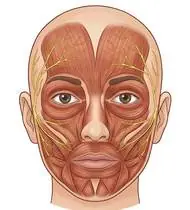
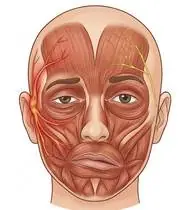
Facial Paralysis (Bell's Palsy) — Overview
Facial Paralysis (Bell's Palsy / Idiopathic Peripheral Cranial Nerve VII Palsy) is an acute lower motor neuron paresis or paralysis of all ipsilateral muscles of facial expression (frontalis, orbicularis oculi, zygomaticus, buccinator, orbicularis oris, platysma) resulting from inflammatory edema/entrapment of the 7th Cranial Nerve within the narrow bony Fallopian (facial) canal (frequently linked to HSV-1 reactivation). CRITICAL CLINICAL DISTINCTION: In a PERIPHERAL (Lower Motor Neuron) lesion, the ENTIRE ipsilateral half of the face—INCLUDING THE FOREHEAD (M. frontalis) and EYE CLOSURE (M. orbicularis oculi)—is paralyzed (with Bell's phenomenon); in a CENTRAL (Upper Motor Neuron / Stroke) lesion, the FOREHEAD IS SPARED due to bilateral cortical innervation! Furthermore, electrical stimulation (Russian/faradic) and forceful grimacing are CONTRAINDICATED in subacute/chronic phases because they trigger aberrant Oculooral Synkinesis!
Facial paralysis (Bell's palsy) is a temporary swelling and pinching of the 7th cranial nerve (facial nerve) inside its narrow bony tunnel behind the ear, causing sudden weakness or drooping on one entire half of your face—including your forehead, eyebrow, eyelid, cheek, and mouth corner. Over 80–85% of people recover well, and following two golden rules—protecting your eye from drying out and using gentle, small mirror-guided movements instead of forceful straining—ensures your smile heals smoothly and naturally!
Primary Causes & Biomechanics
Key Points You Should Know
- •Inflammatory edema and ischemia of CN VII inside the labyrinthine/tympanic/mastoid segments of the temporal bone (or Ramsay Hunt VZV zoster oticus, trauma, parotid tumor, Lyme disease)
- •Associated CN VII branch involvement: Chorda Tympani (loss of taste on the anterior 2/3 of the tongue & decreased salivation), Nerve to Stapedius (hyperacusis — painful sensitivity to loud sounds), and Greater Petrosal Nerve (dry eye / loss of lacrimation)
- •Aberrant Regeneration & Synkinesis Danger: During axonal regrowth, forceful mass contractions ('trying as hard as possible to smile or squeeze eyes shut') cause misdirected axons to cross-wire—so blinking involuntarily pulls the mouth corner (oculooral synkinesis) or smiling narrows the eye!
- •Rule #1 — Protect Your Eye Day and Night: Because the eyelid cannot blink or close tightly at first, the surface of your eye can dry out quickly. Use artificial tear drops every 1–2 hours during the day, wear sunglasses outdoors, and apply eye ointment + gently tape your eyelid closed horizontally at night!
- •Rule #2 — Why Chewing Gum & Hard Grimacing Are FORBIDDEN: Trying to force a huge smile with 100% effort or chewing gum causes the regrowing nerve wires to get crossed (synkinesis—where your eye squints every time you smile or eat!). Always practice tiny, soft, calm movements in front of a mirror.
- •Warm Towel + Gentle Massage: Applying a warm damp towel for 10 minutes before gently massaging your cheek and forehead upward keeps the facial muscles soft and ready.
Assessment Methods
1. Goniometric ROM & Postural / Kinematic Analysis
House-Brackmann Facial Nerve Grading System (Grades I to VI) and Sunnybrook Facial Grading System (0–100: evaluating Resting Symmetry, Voluntary Excursion, and Synkinesis!).
2. Special Clinical Provocation & Neurological/Functional Tests
Forehead Wrinkling & Eyebrow Elevation Check (differentiating peripheral Bell's palsy from central stroke!), Bell's Phenomenon (upward-outward rolling of the eyeball upon attempted eyelid closure), corneal reflex, and inspection of the external auditory canal for Ramsay Hunt herpes zoster vesicles.
3. Standardized Clinical Outcome Scales & Imaging Criteria
Sunnybrook Facial Grading System, House-Brackmann Grade (I–VI), FaCE Scale, and electroneuronography (ENoG) / EMG in severe Grade V–VI cases.
1. Range of Motion & Posture Check
Your physiotherapist gently evaluates how comfortably and smoothly your 7th Cranial Nerve (N. Facialis — stylomastoid foramen / facial canal) and ipsilateral muscles of facial expression moves and checks your overall posture.
2. Muscle Strength & Functional Movement Check
Your muscle balance, walking or reaching comfort, and specific gentle movement tests are evaluated without triggering sharp pain.
3. Typical Symptoms & Daily Impact Review
Rapid onset (over 24–72 hours) of unilateral weakness/drooping of the entire half of the face: inability to wrinkle the forehead or raise the eyebrow, inability to close the eyelid completely (lagophthalmos), flattening of the nasolabial fold, and drooping of the mouth corner.
Treatment Options & Phase-Based Protocol
✨ Enriched GIF Exercise & Precaution GuidePhase 1: Acute Symptom Modulation, Tissue Protection & Early Activation
- •Phase 1 Clinical Focus & Tissue Protection: Phase 1 — Acute Flaccid & Corneal Protection Phase (Days 1–14): Coordinate early oral corticosteroids (within 72h!), MANDATORY Corneal Protection (preservative-free artificial tears every 1–2h by day + lubricating ointment and horizontal eyelid taping/moisture chamber at night to prevent corneal ulceration!), moist warm compress + gentle upward fingertip facial massage, and fingertip-assisted gentle upper eyelid closure.
- •Pain, Edema & Neuromuscular Modulation: Targeted physical modalities, relative load management, and early protected mobility of the 7th Cranial Nerve (N. Facialis — stylomastoid foramen / facial canal) and ipsilateral muscles of facial expression without provoking mechanical or inflammatory irritation.
- •Proximal & Distal Kinetic Chain Maintenance: Maintain active mobility and circulation in adjacent joints while protecting the primary healing structures in Facial Palsy.
Phase 2: Progressive Mobility, Motor Control & Targeted Strengthening
- •Phase 2 Progressive Mobilization & Motor Control: Phase 2 — Mirror Biofeedback Low-Amplitude Neuromuscular Re-Education Phase: NEVER use forceful maximal grimacing or chewing gum! In front of a mirror, perform slow, small-amplitude (40–60% effort) symmetrical movements matching the affected side to the healthy side (gentle brow lift, soft closed-mouth smile, and controlled 'O-U-E-P-B-M' lip shapes).
- •Biomechanical Alignment & Co-Contraction: Restore balanced agonist-antagonist force couples, joint centration, and multi-planar neuromuscular control across the 7th Cranial Nerve (N. Facialis — stylomastoid foramen / facial canal) and ipsilateral muscles of facial expression.
- •Myofascial Extensibility & Endurance: Address secondary compensatory tightness and build local muscular endurance within safe, symptom-free biomechanical parameters.
Phase 3: Functional Integration, Proprioception & Long-Term Prevention
- •Phase 3 Functional Integration & Long-Term Prevention: Phase 3 — Synkinesis Inhibition & Myofascial Release Phase: Intraoral/extraoral cheek & platysma myofascial stretching, dissociation training (moving the lips for 'O-U' while consciously keeping both eyes wide and relaxed!), and symmetrical buccinator/lip seal control.
- •Proprioceptive Balance & Dynamic Loading: Progress to task-specific closed-chain, balance, and functional movement patterns tailored to daily life, occupational, or athletic demands.
- •Self-Management & Relapse Prophylaxis: Establish lifelong ergonomic habits, home exercise maintenance, and early warning-sign awareness to prevent recurrence.
Step 1: Calming Pain, Protecting the Area & Gentle Starter Motion
- •Rule #1 — Protect Your Eye Day and Night: Because the eyelid cannot blink or close tightly at first, the surface of your eye can dry out quickly. Use artificial tear drops every 1–2 hours during the day, wear sunglasses outdoors, and apply eye ointment + gently tape your eyelid closed horizontally at night!
- •Calm Protection & Gentle Start: During the initial stage of Facial Paralysis (Bell's Palsy), avoid painful overloading and perform the gentle, pain-free starter movements shown below to support circulation and comfort.
- •Respecting Your Body's Signals: Every movement should stay within a comfortable, non-painful zone—never force through sharp or radiating pain.
Step 2: Restoring Flexibility & Building Supporting Muscle Strength
- •Rule #2 — Why Chewing Gum & Hard Grimacing Are FORBIDDEN: Trying to force a huge smile with 100% effort or chewing gum causes the regrowing nerve wires to get crossed (synkinesis—where your eye squints every time you smile or eat!). Always practice tiny, soft, calm movements in front of a mirror.
- •Step-by-Step Flexibility & Support: As acute sensitivity settles, gradually build mobility and strengthen the supporting muscles around the joint at a steady, controlled pace.
- •Posture & Breathing Coordination: Keep your posture upright and breathe smoothly (never hold your breath!) during every repetition.
Step 3: Safe Daily Habits, Stamina & Preventing Recurrence
- •Warm Towel + Gentle Massage: Applying a warm damp towel for 10 minutes before gently massaging your cheek and forehead upward keeps the facial muscles soft and ready.
- •Confident Return to Daily Life: Integrate your stronger muscles and improved balance into walking, stairs, work, and recreational activities.
- •Preventing Future Flare-Ups: Continue your core protective habits and key maintenance exercises even after symptoms resolve.
Animated (GIF) Therapeutic Exercise Guide
Animated clinical exercise protocol with biomechanical angles, target muscle groups, and dosage parameters (Click image to enlarge)
Step-by-step animated exercise demonstrations you can safely perform at home (Click image to enlarge)
 🔍 Enlarge
1. Cervical/Platysma Relaxation & Mirror-Guided Symmetric Neuromuscular Preparation
1. Mirror-Guided Shoulder & Facial Relaxation Prep
Releasing neck and platysma co-contraction before a mirror using calm diaphragmatic breathing to establish symmetrical resting facial tone prior to isolated Cranial Nerve VII facilitation. Specifically indicated in Facial Palsy rehabilitation to optimize 7th Cranial Nerve (N. Facialis — stylomastoid foramen / facial canal) and ipsilateral muscles of facial expression biomechanics and neuromuscular control.
Sit in front of a mirror, drop your shoulders, and take a slow breath to completely relax your jaw, neck, and both sides of your face before starting gentle movements. Perform smoothly within a comfortable, pain-free range to support your Facial Paralysis (Bell's Palsy) recovery.
 🔍 Enlarge
2. Mirror Biofeedback Low-Amplitude Isolated Facial Expression Re-Education
2. Mirror-Guided Gentle Symmetrical Brow & Smile Control
Performing slow, small-amplitude (50–60% effort) symmetrical brow elevation and closed-lip corner excursion in front of a mirror. Prevents mass action and aberrant oculooral synkinesis. Specifically indicated in Facial Palsy rehabilitation to optimize 7th Cranial Nerve (N. Facialis — stylomastoid foramen / facial canal) and ipsilateral muscles of facial expression biomechanics and neuromuscular control.
Looking in the mirror, make very small, gentle movements (raising eyebrows or a soft closed-mouth smile) only as far as the weaker side can smoothly match the stronger side without straining. Perform smoothly within a comfortable, pain-free range to support your Facial Paralysis (Bell's Palsy) recovery.
 🔍 Enlarge
3. Myofascial Facial Release & Finger-Assisted Symmetrical Initiation
3. Gentle Upward Fingertip Facial Massage & Support
Following warm moist heat, applying gentle effleurage and myofascial release to the cheek, zygomatic, and perioral tissues to prevent contracture on the hypertonic/recovering side and provide proprioceptive input. Specifically indicated in Facial Palsy rehabilitation to optimize 7th Cranial Nerve (N. Facialis — stylomastoid foramen / facial canal) and ipsilateral muscles of facial expression biomechanics and neuromuscular control.
After applying a warm towel for 5–10 minutes, use your fingertips to gently massage your forehead, cheek, and chin in soft upward and outward circular strokes. Perform smoothly within a comfortable, pain-free range to support your Facial Paralysis (Bell's Palsy) recovery.
 🔍 Enlarge
4. Oculooral Synkinesis Dissociation & Controlled Vowel/Bilabial Articulation
4. Gentle 'O-U-E-P-B-M' Lip Shapes Without Eye Narrowing
Practicing controlled bilabial and rounded vowel postures ('O, U, E, P, B, M') in front of a mirror while consciously keeping the orbicularis oculi relaxed and wide open to inhibit mouth-eye synkinesis. Specifically indicated in Facial Palsy rehabilitation to optimize 7th Cranial Nerve (N. Facialis — stylomastoid foramen / facial canal) and ipsilateral muscles of facial expression biomechanics and neuromuscular control.
In front of a mirror, softly form the sounds 'O, U, E, P, B, M' with your lips while keeping both eyes relaxed and open so your eye does not squint when your mouth moves. Perform smoothly within a comfortable, pain-free range to support your Facial Paralysis (Bell's Palsy) recovery.
 🔍 Enlarge
5. Corneal Protection & Isolated Orbicularis Oculi Gentle Eyelid Closure
5. Fingertip-Assisted Gentle Eyelid Closing
Looking downward while gently guiding the upper eyelid closed with the clean index fingertip (without squeezing the lower face or brow). Protects corneal hydration and trains selective orbicularis oculi fibers. Specifically indicated in Facial Palsy rehabilitation to optimize 7th Cranial Nerve (N. Facialis — stylomastoid foramen / facial canal) and ipsilateral muscles of facial expression biomechanics and neuromuscular control.
Look downward and gently help your upper eyelid close using your clean index fingertip without scrunching your cheek or mouth, hold closed for 5 seconds, and relax. Perform smoothly within a comfortable, pain-free range to support your Facial Paralysis (Bell's Palsy) recovery.
 🔍 Enlarge
6. Buccinator & Orbicularis Oris Symmetrical Lip Seal Competence Training
6. Symmetrical Lip Closure & Gentle Cheek Control
Training symmetrical perioral closure and gentle intraoral air/water retention without over-recruiting the unaffected side. Restores eating, drinking, and speech articulation competence. Specifically indicated in Facial Palsy rehabilitation to optimize 7th Cranial Nerve (N. Facialis — stylomastoid foramen / facial canal) and ipsilateral muscles of facial expression biomechanics and neuromuscular control.
Looking in the mirror, gently bring your lips together symmetrically and hold a small puff of air in the center of your cheeks for 5 seconds without letting air escape. Perform smoothly within a comfortable, pain-free range to support your Facial Paralysis (Bell's Palsy) recovery.
Movements to Avoid & Strict Precautions
1. Chewing Gum, Blowing Up Tight Balloons, or Making Forceful 100% Grimaces (Causes Cross-Wired Synkinesis!)
1. Chewing gum, blowing up hard balloons, or straining your face with maximum effort (causes permanent eye-mouth cross-wiring!)
2. Using High-Intensity Electrical Stimulation (EMS / Faradic) on the Face (Proven to Trigger Facial Contracture & Synkinesis!)
2. Using strong electrical muscle stimulators on your face (increases tightness and involuntary eye twitching!)
3. Sleeping With the Eye Half-Open or Sitting in Direct Wind / Air Conditioning Without Eye Drops
3. Sleeping without eye ointment/tape when your eyelid doesn't close fully, or rubbing your dry eye
4. Doing Exercises Without Looking in a Mirror (Causes Over-Pulling by the Strong Side!)
4. Practicing facial movements without a mirror (your healthy side will pull too hard!)
Facial Paralysis (Bell's Palsy) — Video Guide
Click directly on any video to open and watch in a window, or review details via 📋 Summary & Options.
Condition Overview Video (1 Video)
Summary of pathophysiology, biomechanics, and clinical presentation
What the condition is, why it develops, and its basic mechanism

What Is Facial Paralysis (Bell's Palsy)? Key Precautions During Recovery
Facial Paralysis (Bell's Palsy / Idiopathic Peripheral Cranial Nerve VII Palsy) is an acute lower motor neuron paresis or paralysis of all ipsilateral muscles of facial expression (frontalis, orbicularis oculi, zygomaticus, buccinator, orbicularis oris, platysma) resulting from inflammatory edema/entrapment of the 7th Cranial Nerve within the narrow bony Fallopian (facial) canal (frequently linked to HSV-1 reactivation). CRITICAL CLINICAL DISTINCTION: In a PERIPHERAL (Lower Motor Neuron) lesion, the ENTIRE ipsilateral half of the face—INCLUDING THE FOREHEAD (M. frontalis) and EYE CLOSURE (M. orbicularis oculi)—is paralyzed (with Bell's phenomenon); in a CENTRAL (Upper Motor Neuron / Stroke) lesion, the FOREHEAD IS SPARED due to bilateral cortical innervation! Furthermore, electrical stimulation (Russian/faradic) and forceful grimacing are CONTRAINDICATED in subacute/chronic phases because they trigger aberrant Oculooral Synkinesis!
Facial paralysis (Bell's palsy) is a temporary swelling and pinching of the 7th cranial nerve (facial nerve) inside its narrow bony tunnel behind the ear, causing sudden weakness or drooping on one entire half of your face—including your forehead, eyebrow, eyelid, cheek, and mouth corner. Over 80–85% of people recover well, and following two golden rules—protecting your eye from drying out and using gentle, small mirror-guided movements instead of forceful straining—ensures your smile heals smoothly and naturally!
Treatment and Exercise Videos
Phase-based physiotherapy protocols, mobilization, and therapeutic exercises
Step-by-step recovery and safe home exercise applications

Facial Palsy Treatment: Early Facial Massage and Mirror Biofeedback Exercises
Phase 1: Acute Symptom Modulation, Tissue Protection & Early Activation: Phase 1 Clinical Focus & Tissue Protection: Phase 1 — Acute Flaccid & Corneal Protection Phase (Days 1–14): Coordinate early oral corticosteroids (within 72h!), MANDATORY Corneal Protection (preservative-free artificial tears every 1–2h by day + lubricating ointment and horizontal eyelid taping/moisture chamber at night to prevent corneal ulceration!), moist warm compress + gentle upward fingertip facial massage, and fingertip-assisted gentle upper eyelid closure.
Step 1: Calming Pain, Protecting the Area & Gentle Starter Motion: Rule #1 — Protect Your Eye Day and Night: Because the eyelid cannot blink or close tightly at first, the surface of your eye can dry out quickly. Use artificial tear drops every 1–2 hours during the day, wear sunglasses outdoors, and apply eye ointment + gently tape your eyelid closed horizontally at night!

Bell's Palsy Facial Expression Muscle Neuromuscular Re-Education Exercises
Phase 2: Progressive Mobility, Motor Control & Targeted Strengthening: Phase 2 Progressive Mobilization & Motor Control: Phase 2 — Mirror Biofeedback Low-Amplitude Neuromuscular Re-Education Phase: NEVER use forceful maximal grimacing or chewing gum! In front of a mirror, perform slow, small-amplitude (40–60% effort) symmetrical movements matching the affected side to the healthy side (gentle brow lift, soft closed-mouth smile, and controlled 'O-U-E-P-B-M' lip shapes).
Step 2: Restoring Flexibility & Building Supporting Muscle Strength: Rule #2 — Why Chewing Gum & Hard Grimacing Are FORBIDDEN: Trying to force a huge smile with 100% effort or chewing gum causes the regrowing nerve wires to get crossed (synkinesis—where your eye squints every time you smile or eat!). Always practice tiny, soft, calm movements in front of a mirror.
Clinical Assessment, Goniometry & Special Test Videos
Displayed only in Healthcare Professional mode (hidden in Patient mode)

Facial Nerve (CN VII) Clinical Examination and Facial Muscle Grading
Goniometric ROM & Postural / Kinematic Analysis: House-Brackmann Facial Nerve Grading System (Grades I to VI) and Sunnybrook Facial Grading System (0–100: evaluating Resting Symmetry, Voluntary Excursion, and Synkinesis!).

Systematic Neurological Examination: Reflex, Sensory, Tone, and Motor Assessment
Special Clinical Provocation & Neurological/Functional Tests: Forehead Wrinkling & Eyebrow Elevation Check (differentiating peripheral Bell's palsy from central stroke!), Bell's Phenomenon (upward-outward rolling of the eyeball upon attempted eyelid closure), corneal reflex, and inspection of the external auditory canal for Ramsay Hunt herpes zoster vesicles.